Glass Protection Nets in Kakinada
Protect glazed facades and skylights from impact, debris and bird strike.
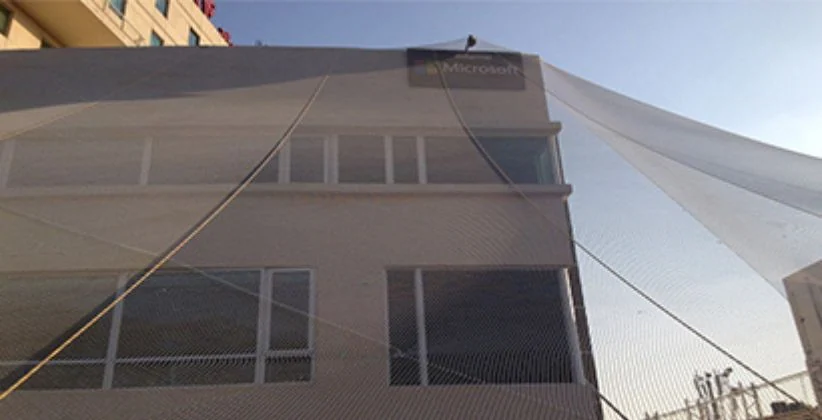
Fitting this in Kakinada
Port city — coastal corrosion plus industrial dust from the harbour side.
316 stainless on the harbour side; coarser mesh so airborne dust passes through rather than matting.
Glass facades and skylights are expensive to replace and awkward to access. A fine net set slightly proud of the glazing absorbs the impact of anything that reaches it, and stops birds striking a reflective surface they cannot see.
The standoff distance matters — mounted flush, the net transfers impact straight to the glass. We set it clear of the surface so the mesh takes the energy.
- Mounted with a standoff so the mesh absorbs impact
- Prevents bird strike on reflective glazing
- Near-invisible from inside at normal viewing distance
- Suits skylights, atria and glazed stairwells
Specification
| Mesh size | 20–25mm |
|---|---|
| Standoff | 100mm minimum from glass |
| Frame | Stainless wire on standoff brackets |
| Warranty | 5-year standard warranty, up to 10 years on HDPE installations |
| Covered in Kakinada | Bhanugudi, Ramaraopeta, Sarpavaram, Gandhinagar |
Local conditions in Kakinada
- Coastal salt plus port dust. 316 stainless on the harbour side; coarser mesh so airborne dust passes through rather than matting.
- Coconut palms. Crown netting is common here — catches the fruit at source and ends the recurring cost of climbing.
- Low-rise stock. Mostly reachable from ladders and light scaffold, which keeps installation straightforward.
Glass Protection Nets in Kakinada — common questions
Do you fit glass protection nets across Kakinada?
Yes — Bhanugudi, Ramaraopeta, Sarpavaram, Gandhinagar and the rest of the city, 4 localities in total. Site inspection is free and usually within 24–48 hours.
Does Kakinada need a different specification?
Port city — coastal corrosion plus industrial dust from the harbour side. 316 stainless on the harbour side; coarser mesh so airborne dust passes through rather than matting.
What material are the nets made from?
Knotted high-density polyethylene, UV stabilised. HDPE is chemically inert, waterproof and does not degrade in sunlight the way untreated polypropylene does. Nets are tensioned on a stainless steel wire frame using screw pins, turnbuckles and hogging staples, so the installation stays tight rather than sagging after the first season.
How much does it cost?
Pricing starts from a base rate per square foot and varies by product — invisible grills cost several times more than netting. Use the estimate calculator for an approximate figure, then book a free site visit for an exact written quotation. Measurements taken over the phone are almost always wrong.
How long will the installation last?
Five years is typical for HDPE netting in direct sun, longer on sheltered elevations. Invisible grills last considerably longer — the stainless cable is the limiting component and it does not corrode. Sun exposure is what ages netting, not rain.
Glass Protection Nets in Kakinada — get a price
Free inspection anywhere in Kakinada. We measure, recommend the right specification for local conditions, and quote in writing.